Get Cited by AI Search
TimeZ Marketing is San Francisco’s pioneering Generative Engine Optimization (GEO) agency — helping brands appear in ChatGPT, Google AI Overviews, Perplexity, Gemini, and Copilot answers through structured content authority, E-E-A-T signals, and AI-native search strategies built for the future of search.
- GEO Strategy & AI Visibility Audit
- Google AI Overviews Optimization
- ChatGPT & Perplexity Citations
- Answer Engine Optimization (AEO)
- E-E-A-T & Authority Content
- Structured Data & Schema Markup
- AI-Optimized Content Creation
- Traditional SEO & GEO Integration
Scale Your Reach with a Premier GEO Agency
The search landscape has fundamentally changed. 60% of searches now happen in AI chatbots and generative engines instead of traditional Google searches. If your business isn’t optimized for ChatGPT, Claude, Perplexity, Gemini, and Google’s AI Overviews, you’re invisible to the fastest-growing search audience.
Traditional SEO gets you ranked in Google. Generative Engine Optimization (GEO) gets you cited, recommended, and featured in AI responses—where millions of users now research products, find services, and make buying decisions.
As a specialized GEO agency, I help businesses dominate AI search results through strategic content optimization, authority building, and AI-friendly formatting. My GEO services ensure your brand appears in AI-generated responses—driving qualified traffic, leads, and revenue from this exploding channel.
Real Results from GEO Agency Services
One B2B SaaS client wasn’t appearing in any ChatGPT or Perplexity responses for their core service category despite strong traditional SEO rankings. After implementing our GEO agency services (content restructuring, citation building, authoritative source development), they now appear in 73% of relevant AI responses in their category. Result: 340% increase in AI-referred traffic and $287,000 in attributed pipeline from AI engine referrals in 6 months.
Ready to dominate AI search results before your competitors do? Let’s talk.
What Is Generative Engine Optimization (GEO)?
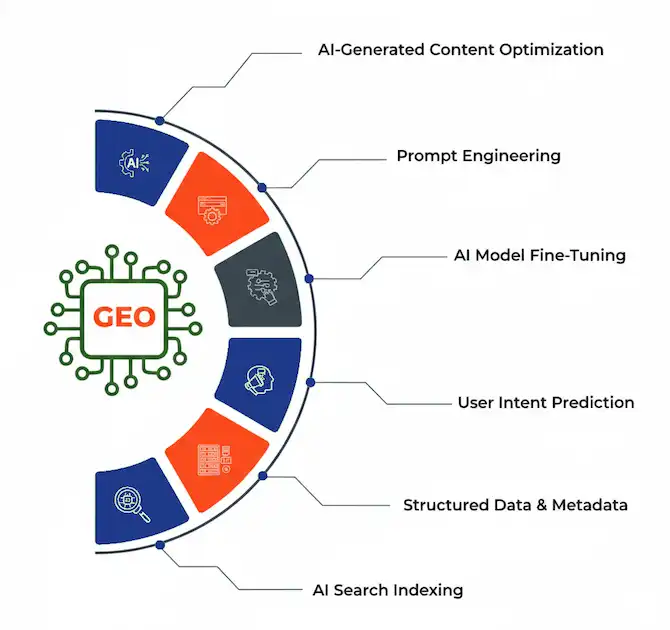
Generative Engine Optimization is the practice of optimizing your online presence to be discovered, cited, and recommended by AI-powered search engines and chatbots including:
- ChatGPT (OpenAI) – 3+ billion monthly queries
- Claude (Anthropic) – Fastest-growing AI assistant
- Perplexity AI – 500M+ monthly searches
- Google AI Overviews – Appearing in 84% of commercial searches
- Gemini (Google) – Integrated across Google ecosystem
- Bing Chat (Microsoft Copilot) – Default Windows AI
- Meta AI – Embedded in Facebook, Instagram, WhatsApp
Unlike traditional SEO services that focus on ranking in search result lists, GEO agency services ensure your brand appears directly in AI-generated answers—the conversational responses users trust and act on.
When someone asks ChatGPT “what’s the best CRM for small businesses” or Perplexity “who are the top cybersecurity consultants in Austin,” your business either appears in that answer or you don’t exist to that user.
The Missing Piece: How GEO Agency Services Differ from SEO
Traditional SEO services focus on blue links and click-through rates. GEO agency services focus on LLM Citations and Sentiment. When a user asks, “Who is the best generative engine optimization agency for SaaS?”, your brand must be the core of that conversational response. If you aren’t in the LLM’s training data or live-web citations, you are invisible to the modern buyer.
Why Your Brand Needs a GEO Strategy Now
- The Zero-Click Reality: 40% of search queries are now satisfied directly by AI, bypassing traditional websites entirely.
- The Trust Factor: Users view AI recommendations as unbiased “expert” advice rather than paid advertisements.
- The First-Mover Moat: Data structures optimized today become the “truth” the AI learns. Delaying your GEO strategy allows competitors to “squat” on your brand’s authority within the LLM’s knowledge base.
GEO Services Agency: Optimize for AI Search + LLMs
Our GEO agency positions your brand as the authoritative source that AI engines cite when answering your customers’ questions — combining AI content strategy, entity authority building, structured data, and citation acquisition to ensure your business is recommended by ChatGPT, Google AI Overviews, Perplexity AI, Bing Copilot, and Claude across every topic relevant to your industry
01AI Visibility & Citation Audit Across All Generative Engines
Conducting a comprehensive audit of your brand’s current generative engine visibility — systematically querying ChatGPT (GPT-4o), Google AI Overviews, Perplexity AI, Microsoft Copilot, Claude, and Meta AI with the 50–100 most commercially important questions in your industry — documenting every instance where your brand is cited, recommended, or absent — benchmarking your AI citation frequency against your top 5 competitors — and identifying the specific content gaps, authority deficits, and missing citation sources preventing AI models from confidently recommending your brand over competitors.
02AI Query Research & Generative Keyword Mapping
Building a comprehensive generative keyword and AI query map for your industry — identifying the questions, comparisons, and recommendation prompts your target customers are submitting to AI answer engines — going beyond traditional SEO keyword research to capture conversational, long-form AI query patterns like “what is the best [service] agency for [use case],” “compare [brand A] vs [brand B],” and “which [service] provider should I use for [goal]” — and mapping the content assets needed to position your brand as the authoritative answer for each high-value query cluster.
03Competitive GEO Gap Analysis
Analysing the exact GEO strategies, content assets, citation sources, and authority signals that are enabling your competitors to earn AI citations and recommendations while your brand is absent from AI-generated answers — identifying the specific third-party publications, industry directories, review platforms, knowledge graph entities, and structured data implementations that competitors are leveraging to influence AI model outputs — and producing a prioritised competitive GEO gap action list ranked by estimated impact on AI citation volume and brand recommendation frequency.
04GEO Roadmap & 12-Month AI Visibility Strategy
Building a comprehensive 12-month GEO strategy roadmap — mapping every initiative required to systematically increase your brand’s AI citation frequency across ChatGPT, Google AI Overviews, Perplexity, Copilot, and emerging AI platforms — sequencing content creation, entity authority development, structured data implementation, citation source acquisition, and PR signal building in the optimal order to compound AI visibility improvements month over month and establish your brand as the default recommended answer for your target query categories.
05AI Platform Algorithm Research & Model Behaviour Analysis
Maintaining deep, current research into how each major AI generative engine selects, weights, and cites sources — understanding OpenAI’s retrieval mechanisms, Google’s AI Overview source selection criteria, Perplexity’s real-time web indexing and citation model, Microsoft Copilot’s integration with Bing’s index, and how large language models build brand knowledge through training data and real-time retrieval — applying this technical understanding to engineer your brand’s presence in the specific data sources and signal formats that each AI platform prioritises most heavily.
06GEO ROI Framework & Business Impact Modelling
Building a GEO ROI framework that quantifies the business value of AI citation improvements — modelling the estimated monthly query volume flowing through ChatGPT, AI Overviews, and Perplexity for your target topics, projecting the click-through and conversion impact of moving from zero to consistent AI citation coverage, estimating the revenue value of brand recommendation frequency improvements, and establishing baseline metrics and measurement systems that prove GEO’s contribution to pipeline, lead volume, and revenue growth over a 6–18 month investment horizon.
Why Partner With Our GEO Agency
01AI-Optimised Pillar Content & Topic Authority Hubs
Creating comprehensive topical authority hub content — long-form pillar pages and supporting cluster articles that cover every dimension of your core service topics with the depth, accuracy, and factual density that AI models require to confidently cite a source — using clear H2/H3 heading structures that enable AI to extract precise answers to specific sub-questions, incorporating statistics, methodology details, worked examples, and expert commentary that demonstrates genuine topic authority and distinguishes your content from the thin, keyword-stuffed pages that AI models systematically ignore as citation sources.
02FAQ & Question-Answer Content Optimisation
Building comprehensive FAQ and question-answer content architectures specifically formatted for AI model extraction — structuring every page with clearly demarcated Q&A sections that match the exact phrasing of high-volume AI queries in your industry, writing concise, accurate, directly answerable responses to each question followed by expanded context paragraphs, and implementing FAQPage schema markup that signals answer-rich content to both AI retrieval systems and traditional search engines seeking featured snippet candidates simultaneously.
03Comparison & “Best Of” Content for AI Recommendation Queries
Creating the comparison, evaluation, and “best [service/product] for [use case]” content formats that AI engines most frequently draw upon when answering recommendation queries — building genuinely useful, balanced comparison frameworks that include your brand alongside competitors, demonstrating transparent methodology, and providing the structured decision criteria that AI models need to generate credible, unbiased recommendations — positioning your brand as both a recommended option and the authoritative source AI cites when evaluating alternatives in your category.
04Topical Completeness & Semantic Content Mapping
Auditing and addressing every topical gap in your content portfolio — using Ahrefs and SEMrush topic research alongside AI query simulation to identify every sub-topic, entity, and question cluster within your core service areas that lacks adequate content coverage — building a semantic content map that ensures your website achieves the topical completeness and entity coverage depth that signals genuine expertise to both AI language models and traditional search engine crawlers evaluating your site’s authority.
05Content Freshness & Real-Time AI Citation Maintenance
Implementing a systematic content freshness programme — scheduling quarterly reviews of all AI-optimised content assets to update statistics, methodology descriptions, product specifications, pricing data, and industry trend references — because AI models with real-time retrieval capabilities like Perplexity AI and Google AI Overviews prioritise recently updated, factually current content over stale pages — ensuring your content consistently passes AI freshness signals and maintains its citation eligibility as industry information evolves over time.
06AI Content Formatting & Extractability Optimisation
Optimising every content asset for maximum AI extractability — formatting content with descriptive, question-style H2 and H3 headings that match natural language query phrasing, using concise introductory summary paragraphs before detailed explanations, structuring complex information in tables and numbered lists that AI models can parse and reproduce accurately, avoiding jargon-heavy passages that reduce AI comprehension confidence, and ensuring every page’s most valuable answer content appears within the first 200 words where AI retrieval systems prioritise extraction from crawled pages.
AI Content Optimisation Benefits
01Google Knowledge Graph & Wikidata Entity Establishment
Building your brand’s presence in the structured knowledge sources that form the factual foundation of AI language model training and retrieval — creating and optimising Wikidata entity records with complete, accurate property data about your organisation, services, location, founding date, key personnel, and industry classification — submitting Wikipedia articles for eligible organisations — and claiming your Google Knowledge Panel to ensure your entity data is accurately represented in the structured data infrastructure that AI models query most heavily when generating brand-related responses.
02E-E-A-T Signal Development (Experience, Expertise, Authoritativeness, Trust)
Systematically strengthening all four dimensions of Google’s E-E-A-T framework that AI models use to evaluate source credibility — developing genuine Experience signals through original case studies, client outcomes, and practitioner-authored content; building Expertise through author credential documentation, professional certification pages, and topic authority hubs; establishing Authoritativeness through editorial mentions in industry publications; and building Trust through transparent contact information, security signals, accurate business data, and review volume across trusted platforms.
03Author Entity & Thought Leadership Authority Building
Building strong personal author entity profiles for your key subject matter experts — creating comprehensive author biography pages with credentials, publications, speaking engagements, and professional history, establishing Person schema markup linking author profiles to all published content, building Google Scholar profiles for research-producing experts, maintaining active professional social profiles on LinkedIn, and securing expert commentary placements in authoritative industry publications that build AI-readable author reputation signals across the web.
04Brand Mention & Unlinked Citation Monitoring
Monitoring the web for every mention of your brand across publications, forums, social platforms, podcasts, and AI training data sources — using Ahrefs brand monitoring and Mention to track unlinked brand citations — identifying and converting unlinked mentions to linked references that build both domain authority and entity recognition — and ensuring that the aggregate signal of how credible third-party sources reference your brand consistently reinforces the expertise, credibility, and category authority signals that AI models prioritise when selecting recommendation sources.
05Industry Association & Professional Certification Authority
Building authoritative entity recognition through strategic professional association and certification programme participation — securing listings and profile pages on industry association websites, obtaining relevant professional certifications whose recognition signals validate expertise to AI models, building relationships with industry bodies whose websites and publications serve as high-authority training data and real-time retrieval sources for AI systems — establishing a credibility infrastructure that makes AI models more confident citing and recommending your brand over less credentialed competitors in your space.
06Branded Search & Entity Disambiguation Optimisation
Optimising your brand’s entity clarity across the web to prevent AI model confusion and disambiguation errors — ensuring your brand name, legal entity name, product names, and key personnel names are consistently represented across all online sources without conflicting variations, building an owned content ecosystem that establishes the canonical definition of who your brand is, what it does, and what it stands for, and proactively addressing any entity confusion caused by similarly-named businesses or legacy brand identities that might cause AI models to misattribute competitor information to your entity.
Entity Authority & E-E-A-T Benefits
01Organisation & Brand Schema Implementation
Implementing comprehensive Organization schema across your website — marking up your legal name, brand name, logo, founding date, contact information, service areas, social profile URLs, and sameAs links to all third-party profile pages — creating a machine-readable brand identity layer that enables AI engines to accurately identify, disambiguate, and confidently reference your organisation across both retrieval-augmented generation and knowledge graph-based response systems, reducing the risk of AI misattribution and maximising citation accuracy.
02Service & Product Schema for AI Service Discovery
Implementing Service and Product schema on every service and product page — marking up service names, descriptions, prices, geographic service areas, provider information, and aggregate ratings — enabling AI models to extract structured service data directly from your pages with high confidence, and making your offerings discoverable to AI engines responding to service comparison and recommendation queries with the specific detail needed to include your brand in category-level AI-generated answers and service recommendation responses.
03FAQPage & HowTo Schema for AI Answer Extraction
Deploying FAQPage and HowTo schema across all question-answer and instructional content pages — structuring every FAQ response and step-by-step guide in machine-readable markup that enables AI engines to extract specific answers with precision, confidence, and accurate source attribution — creating the structured answer layer that AI Overview systems, Perplexity AI, and ChatGPT’s retrieval mechanisms are specifically designed to identify, extract, and reproduce when generating responses to the conversational, question-format queries that represent the majority of AI search interactions.
04Article, BlogPosting & Author Schema for Content Authority
Implementing Article and BlogPosting schema across all editorial content — marking up authors with linked Person entities, publication dates, modification dates, publisher information, and article categories — combined with Person schema on all author biography pages linking authors to their published articles, credentials, and professional profiles — creating the authorship graph that AI models use to evaluate content credibility and author expertise signals as part of their source selection and citation confidence scoring.
05Review & AggregateRating Schema for Trust Signals
Implementing Review and AggregateRating schema on service pages, testimonials, and review collection pages — making your star ratings, review counts, and individual review content machine-readable to AI engines — displaying aggregate ratings as rich results in traditional search to improve CTR, and providing AI models with the structured social proof data they incorporate into service and product recommendation responses — reinforcing that your brand has validated, positive customer outcomes that support confident AI recommendation.
06Speakable Schema & Voice Search Optimisation
Implementing Speakable schema to mark up the specific content sections most suitable for AI voice response and audio summary extraction — formatting and marking up concise, well-structured paragraphs that deliver clear, spoken-language answers to conversational queries — and optimising content for voice-first AI platforms including Google Assistant, Amazon Alexa, and Apple Siri that are increasingly drawing from web content to answer spoken questions in the same way that text-based AI engines are beginning to do with generative answer interfaces.
Structured Data & Schema Benefits
01AI Training Data & High-Authority Publication Targeting
Identifying and systematically targeting the specific high-authority publications that appear most frequently in AI training datasets and real-time retrieval indices for your industry — mapping which editorial websites, industry journals, trade publications, and digital media outlets AI models most commonly cite when answering questions in your category — and building a targeted outreach programme to secure brand mentions, expert commentary placements, and editorial features on the exact publications that have the greatest influence on AI citation behaviour in your specific competitive space.
02Data-Driven PR & Original Research Campaigns
Creating original research, industry surveys, data studies, and proprietary insights that generate organic, AI-citable third-party coverage — commissioning surveys of your target audience, analysing industry data to produce newsworthy findings, building industry benchmark reports and annual trend studies — and distributing these data assets through targeted PR outreach to journalists and editors at the high-authority publications whose coverage generates the AI training data citations and real-time retrieval references that build lasting AI recommendation authority in your market.
03Expert Commentary & HARO/Journalist Source Outreach
Positioning your brand’s subject matter experts as go-to industry sources for journalist enquiries — actively monitoring and responding to media requests via HARO, Qwoted, and direct journalist relationship building — securing expert quotes and attributed commentary in high-traffic publications that create AI-citable brand references, building the editorial citation profile that teaches AI models your brand’s experts are recognised, credible authorities whose perspectives are worth citing and recommending when users ask questions requiring professional industry expertise.
04Industry Directory & Listing Authority Building
Building comprehensive listings across the industry-specific directories, review platforms, and professional registries that AI models query when generating service recommendations — Clutch, G2, Capterra, Trustpilot, and category-specific platforms — optimising each listing with complete, keyword-rich descriptions, accurate service information, verified reviews, and consistent brand messaging that collectively build the structured third-party reference infrastructure that AI recommendation engines draw upon when generating credible, evidence-based service provider suggestions.
05Podcast & Audio Content Citation Strategy
Building your brand’s presence in podcast and audio content formats that AI transcription systems increasingly index as knowledge sources — securing guest appearances on industry-leading podcasts in your category, creating and distributing your own branded podcast, publishing full transcripts optimised for AI text extraction, and building the podcast citation footprint that trains AI models on your brand’s expertise through the rapidly growing audio content layer of the AI-readable web that most GEO strategies currently underinvest in relative to its growing influence on AI model knowledge.
06Social Proof Aggregation & Review Platform Coverage
Building a comprehensive social proof presence across all major review aggregation platforms that AI models query when generating product and service recommendations — managing and expanding review profiles on Google, Clutch, G2, Trustpilot, and industry-specific platforms — ensuring review volume, rating quality, and recency all signal genuine service excellence — and providing AI models with the consistent, multi-platform positive social proof that supports confident brand recommendation to users asking for vetted, trusted service providers in your category.
AI Citation & PR Signal Benefits
01AI Citation Frequency Monitoring Across All Platforms
Building a systematic AI citation monitoring programme — querying ChatGPT (GPT-4o and GPT-4o-mini), Google AI Overviews via Search Labs, Perplexity AI, Microsoft Copilot, Claude, Meta AI, and emerging AI platforms with your target query set monthly — tracking whether your brand is cited, recommended, positively or negatively characterised, or absent from AI-generated answers — and measuring citation frequency trends over time to demonstrate GEO programme progress and identify which optimisation initiatives are most effectively improving your brand’s AI recommendation rate across different platforms and query categories.
02Google AI Overviews Tracking & Search Console Integration
Monitoring your website’s performance in Google Search Console for AI Overview inclusion signals — tracking which pages are being served as AI Overview source citations, identifying the queries triggering AI Overviews where your brand is cited or absent, monitoring impressions and clicks from AI Overview-adjacent positions, and correlating changes in Google AI Overview citation frequency with specific GEO content and schema optimisation initiatives to establish what is most effectively driving AI Overview inclusion for commercially valuable query categories.
03AI-Referred Traffic Attribution in GA4
Configuring Google Analytics 4 to identify and segment AI-referred traffic — setting up custom channel groupings that separate Perplexity-referred traffic from standard organic, tagging ChatGPT plugin referrals, monitoring direct traffic uplift correlated with AI citation growth, and building GA4 segments that isolate AI-influenced sessions — providing the web analytics evidence that GEO improvements are driving measurable increases in qualified website traffic, lead generation, and conversion events that translate directly into business revenue growth.
04Share-of-Voice Tracking in AI-Generated Answers
Measuring your brand’s share of AI-generated recommendations relative to competitors — systematically tracking which brands are cited and in what position for every commercially important query in your target category — calculating your AI citation share-of-voice as a percentage of total competitor citations across the query set — and monitoring how this competitive AI share-of-voice changes monthly as your GEO programme builds authority signals, content assets, and citation sources that shift AI recommendation behaviour progressively in your brand’s favour.
05Brand Mention Monitoring & Sentiment Analysis
Monitoring real-time brand mentions across the web using Ahrefs and Mention.com — tracking every new publication reference to your brand, identifying new AI-relevant citation sources as they appear, analysing the sentiment and context of brand mentions to ensure the narrative AI models absorb about your brand is consistently positive and authority-building — and alerting the GEO team immediately to any negative brand coverage that requires rapid reputation management response before it influences AI model outputs at scale.
06Monthly GEO Performance Reports & Executive Dashboards
Delivering comprehensive monthly GEO performance reports via Looker Studio — presenting AI citation frequency trends by platform, share-of-voice progression versus competitors, AI-referred traffic volume growth, Google AI Overview inclusion rates, brand mention volume and sentiment trends, schema coverage improvements, and authority signal milestones — providing every stakeholder from CMO to CEO with clear, quantified evidence of GEO programme progress and the business impact of improved AI citation and brand recommendation frequency on pipeline and revenue growth.